 Openers and Power Cuts in Baltimore Garages
Baltimore's older housing stock and severe cold winters mean openers fail at the worst time.
BlogBaltimore, MD · 4 min read
What That Noise Is Actually Telling You
Baltimore's 1960s-70s housing stock and severe cold winters mean specific garage door noises point to specific failures. Here's what to listen for and what it costs.
Local detail
How Local Conditions Play In
Housing across this service area went up mostly between 1955 and 2014, with the typical house dating to 1978, and the heaviest concentration of builds sitting in the 1960s and 70s across the named communities we work in. That matters because a door and opener installed during that build-out is old enough now that the grease has dried out of the bearings and the spring steel has fatigued past where it was rated. Add a climate band that runs severe cold, and steel contracts, lubricant stiffens, and hardware that was already tired starts complaining louder in January than it did in July. A door that was quiet all summer and starts groaning the first cold week isn't coincidence. It's the same wear finally showing up under thermal stress. Houses built in that era also tend to have single torsion springs sized for lighter doors, not the heavier insulated steel panels a lot of owners have since swapped in, so the spring is working harder than it was ever meant to. None of this is unique to one block or one neighborhood - it's a pattern tied to when this part of the region built out, and it shows up from Cherry Hill to Rosedale to Perry Hall the same way, just on different timelines depending on when each pocket went up.
The area
What Is Going On
A grinding sound when the door starts moving usually means a roller that's lost its bearing race, not the track itself - common in houses from that 1960s-70s wave where steel rollers were standard and nobody's swapped them in decades. A rhythmic thump once per rotation points to a flat spot on a roller or a bent track section, something cold weather makes worse because the metal is less forgiving when it's contracted. A loud bang, usually once, is a spring letting go - and on original torsion hardware from a house built mid-century, that's not a surprise, it's overdue. A slow grinding whine from the opener itself, especially one that's been there since the house was built or shortly after, is usually a stripped gear, which is a wear part, not a sign of abuse. The specific sound tells you which part is failing, and in a lot of these older homes, it's whichever part has been working hardest the longest - usually the spring, since it cycles under full tension every single time the door moves, twice a day, for decades.
What we find
What Most People Get Wrong
The common mistake is spraying WD-40 on a noisy spring or track and calling it fixed for a week. It quiets things down briefly because it's a solvent, not a lubricant, and it actually strips what grease is left. On original hardware from houses built in that 1960s-70s stretch, that grease was already thin. The other mistake is assuming a noisy opener motor needs a new motor, when nine times out of ten in an older installation it's the gear kit or the chain tension, both cheaper fixes than a full replacement. People also wait through a whole cold season on a door that's dragging, assuming it'll loosen up once spring comes. It won't - a spring that's lost tension in January has lost it for good, cold just exposes it faster. One honest limitation: if the opener is original to a house built in that era, parts for some of those older chain-drive units aren't made anymore, and at that point replacement is the only real option, not a repair.
How we work
What You Pay
We don't have a universal number to hand you here, because what a noise costs to fix depends entirely on which part failed and how old the rest of the hardware is - a roller swap on an otherwise sound door is a different job than a spring and cable replacement on a 40-year-old torsion system. With median household income across this service area at $109,661, most owners here can reasonably plan for either a targeted repair or, when the hardware's original to the house, a full opener and spring upgrade rather than patching a system that's going to keep failing piece by piece. Ask for a breakdown of parts versus labor before you agree to anything, and if a tech tells you the whole door needs replacing over one bad roller, get a second opinion.
Questions
Common questions
Why does my garage door only make noise in winter?
Cold contracts steel and stiffens old grease, so wear that was already there in the spring and cables shows up louder once temperatures drop into the severe cold range we get here. The underlying damage was there all along - cold just removes the slack that was hiding it.
Is a banging noise always a broken spring?
Usually, especially on older torsion systems common in houses built here in the 1960s and 70s. A single loud bang followed by the door refusing to open or feeling heavy is almost always a spring that's let go. It's not a job to force through with the opener.
My opener grinds but still works - can I wait?
You can, but a grinding gear kit is a wear part failing in slow motion, and it tends to go from grinding to not-moving with little warning. On an opener original to a house built decades ago, waiting usually means a breakdown at an inconvenient time rather than money saved.
Recommendation
You Might Also Like
More garage door guides for Baltimore homeowners.
Openers and Power Cuts in Baltimore Garages
Baltimore's older housing stock and severe cold winters mean openers fail at the worst time.
 When a Spring Goes in Cold Weather in Baltimore
Baltimore's 1960s-70s housing stock and severe cold winters put real strain on torsion springs.
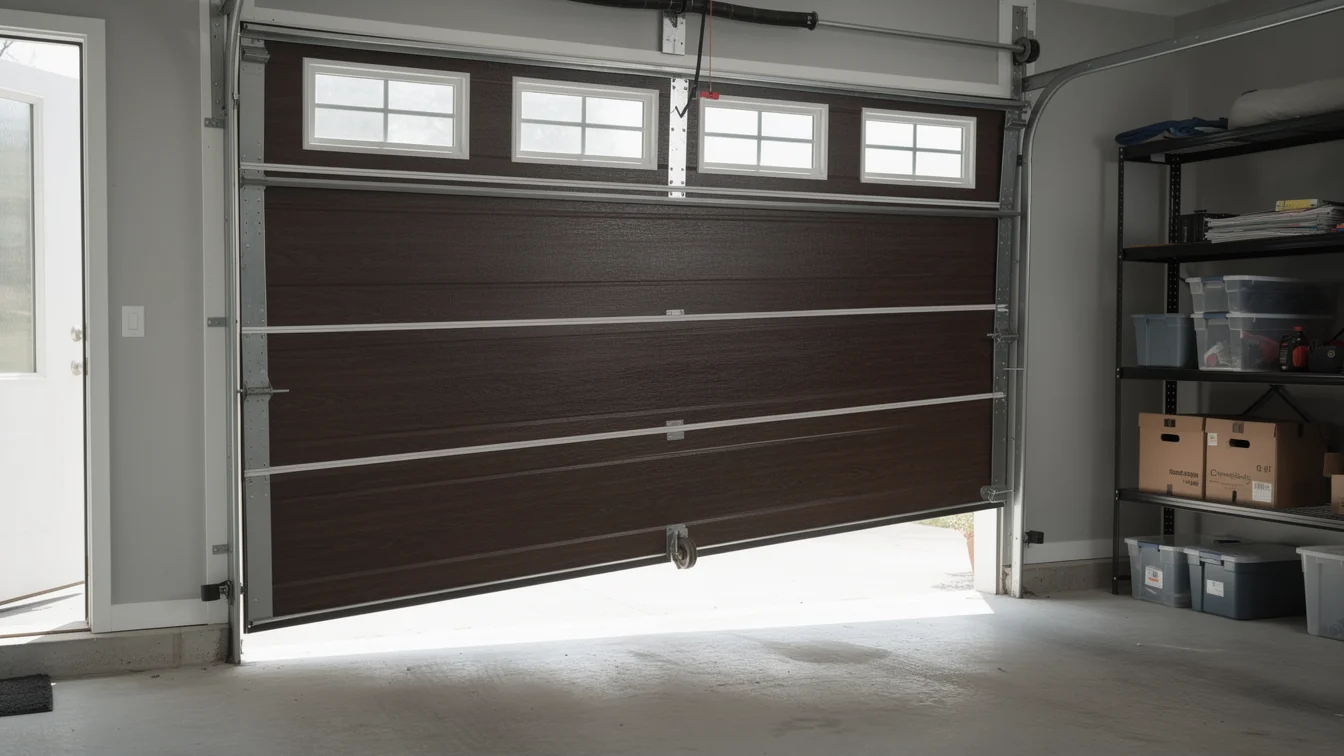 Why a Garage Door Goes Off Track Around Baltimore
Baltimore's 1960s-70s housing stock and cold winters push doors off track in specific ways.
Ready when you are
Need a garage door sorted in Baltimore?
Baltimore Garage Door Pros repairs and installs garage doors, springs and openers in Baltimore, MD and the surrounding area.